MPO vs MTP® Connectors: What's the Real Difference and Which Should You Specify?
MPO and MTP® are not competing standards. One is the open industry specification; the other is a trademarked, engineered upgrade of that spec.
Key Takeaways
MTP® is US Conec's trademarked version of the MPO standard. All MTP® connectors are MPO, but not all MPO connectors are MTP®.
MTP® delivers insertion loss of 0.15 to 0.35 dB vs. 0.35 to 0.75 dB for generic MPO, thanks to a floating ferrule and elliptical guide pins.
Standard MPO is rated for approximately 500 mating cycles under normal use; MTP® exceeds 1,000 cycles, which is critical in frequently reconfigured environments.
Both connectors use the same adapters and comply with IEC 61754-7 and TIA-604-5, so they are physically interchangeable.
Choose MTP® for 100G+ links and high-churn environments. Generic MPO works for static, cost-sensitive deployments.
What Is the MPO Connector?
MPO, or Multi-Fiber Push-On, is an open industry standard defined by IEC 61754-7 and TIA-604-5 (FOCIS-5). Any manufacturer worldwide can produce MPO connectors as long as they meet those specs. The connector houses multiple fibers in a single rectangular MT (Mechanical Transfer) ferrule, typically in 8-, 12-, 16-, 24-, or 32-fiber configurations.
MPO connectors replaced individual LC/SC duplex patching in high-density environments because they cut field termination time dramatically. One push connects 12 or 24 fibers simultaneously, a fact that reshaped how data centers handle structured cabling at scale.
The connector uses a push-pull latch, guide pins for fiber alignment, and a keyed housing to control polarity. Male connectors carry the guide pins; female connectors don't.
Polarity determines which fiber carries transmit and which carries receive across a link. If you are new to MPO polarity methods, see our guide: MPO Polarity Explained: Type A, Type B, and Type C.
What Is the MTP® Connector, and How Is It Different?
MTP®, or Multi-Fiber Termination Push-On, is a registered trademark of US Conec. It's an engineered, proprietary version of the MPO connector that complies fully with IEC 61754-7 and TIA-604-5, meaning it physically mates with any standard MPO connector in the field.
Three core changes separate MTP® from generic MPO:
1. Floating Ferrule vs. Fixed MT FerruleStandard MPO uses a fixed MT ferrule. MTP® upgrades to a floating ferrule design that self-adjusts during mating, compensating for minor angular misalignments. The result is more consistent fiber-to-fiber contact and more stable insertion loss across repeated connections. | 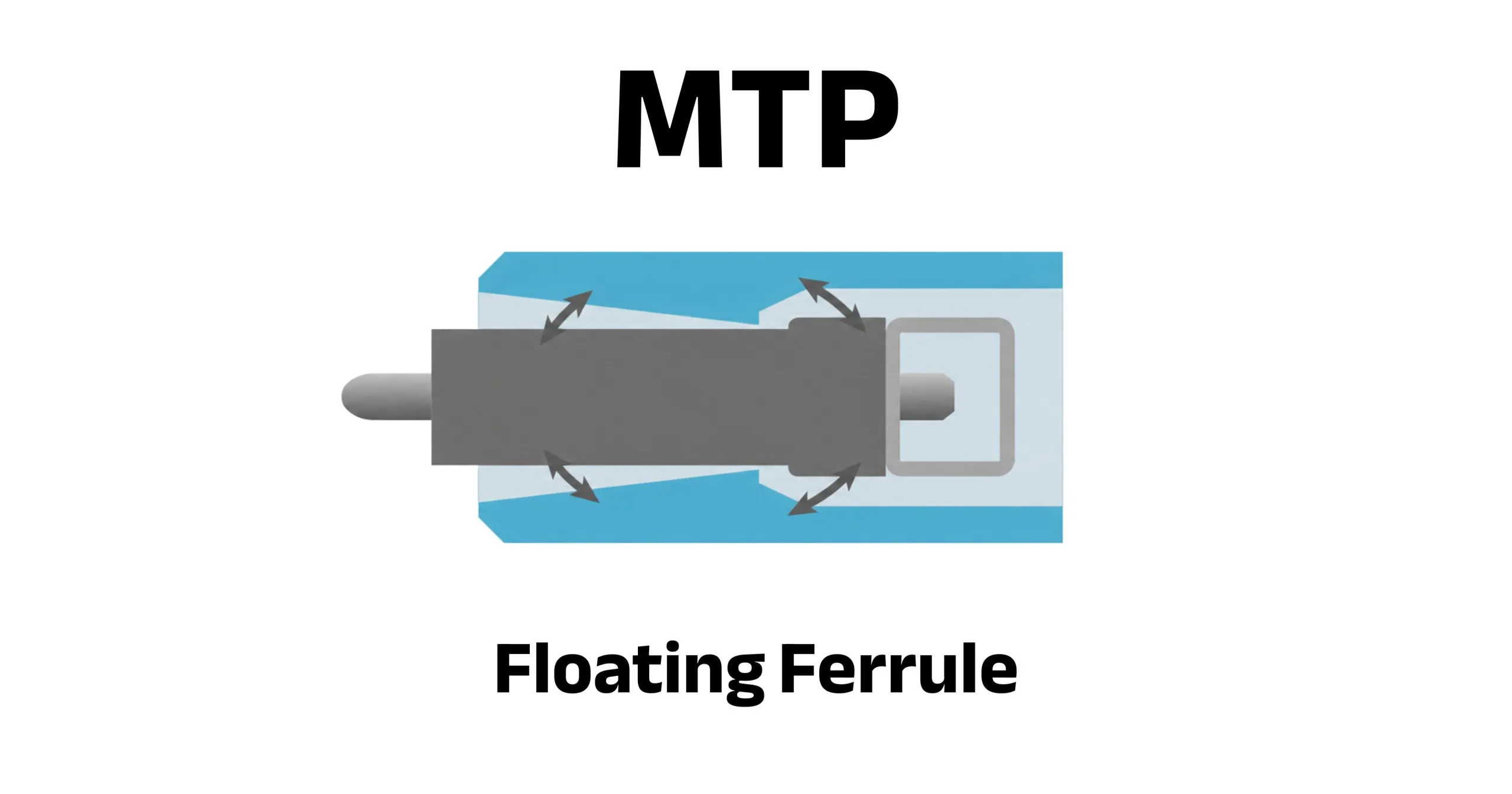 |
2. Elliptical Guide Pins vs. Flat-Tipped Guide PinsGeneric MPO guide pins have flat tips, which generate particulate debris during mating as pin surfaces grind against the guide hole opening. MTP® uses elliptically-shaped, stainless steel guide pins with tighter tolerances. The oval tip displaces rather than scrapes, reducing contamination and extending pin life. | 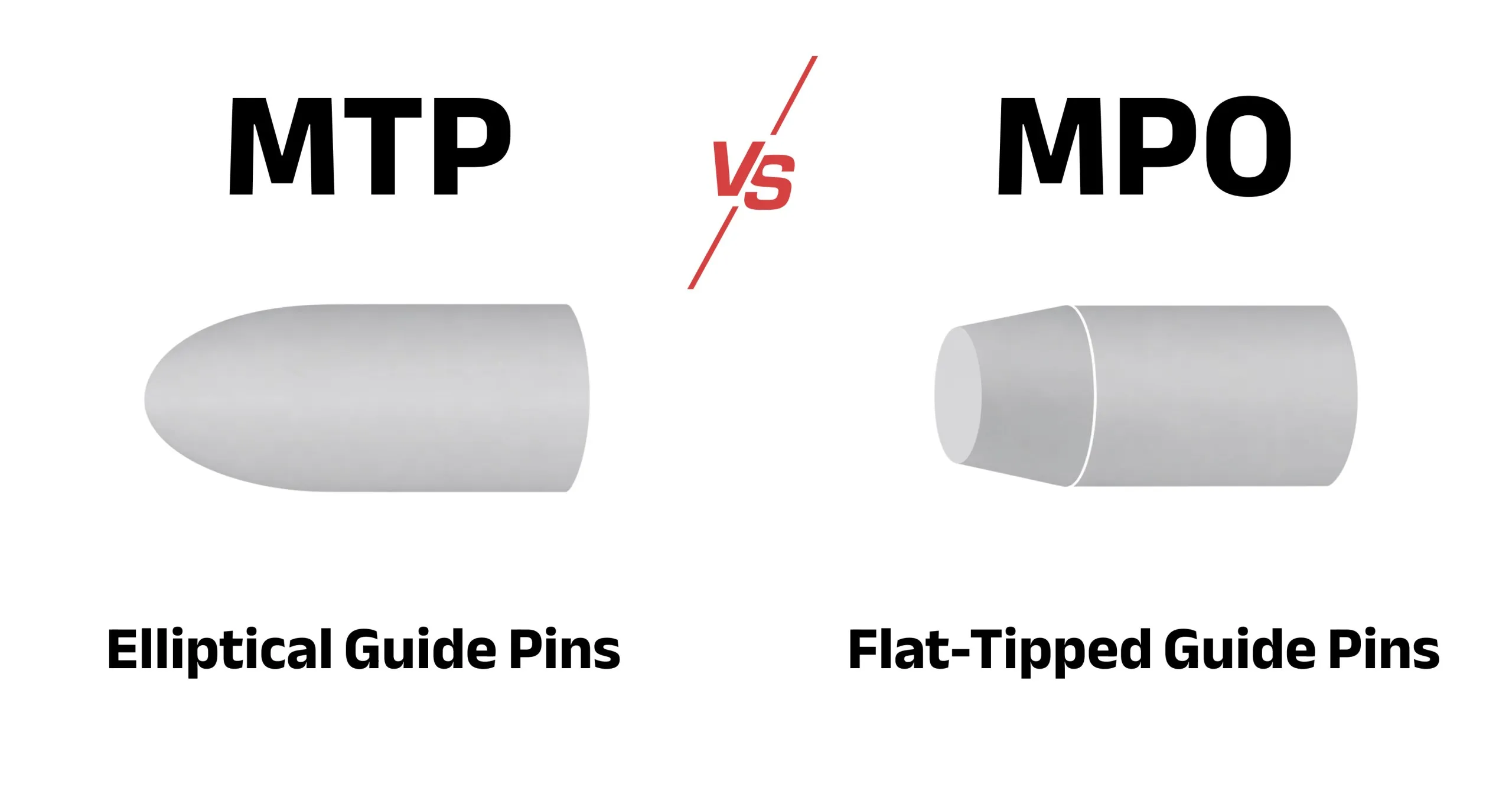 |
3. Metal Pin Clamp vs. Plastic Pin ClampStandard MPO connectors use plastic pin clamps, which can break under repeated mating stress. MTP® uses a metal pin clamp that holds guide pins more securely, reducing the risk of pin breakage during high-churn installation and maintenance cycles. | 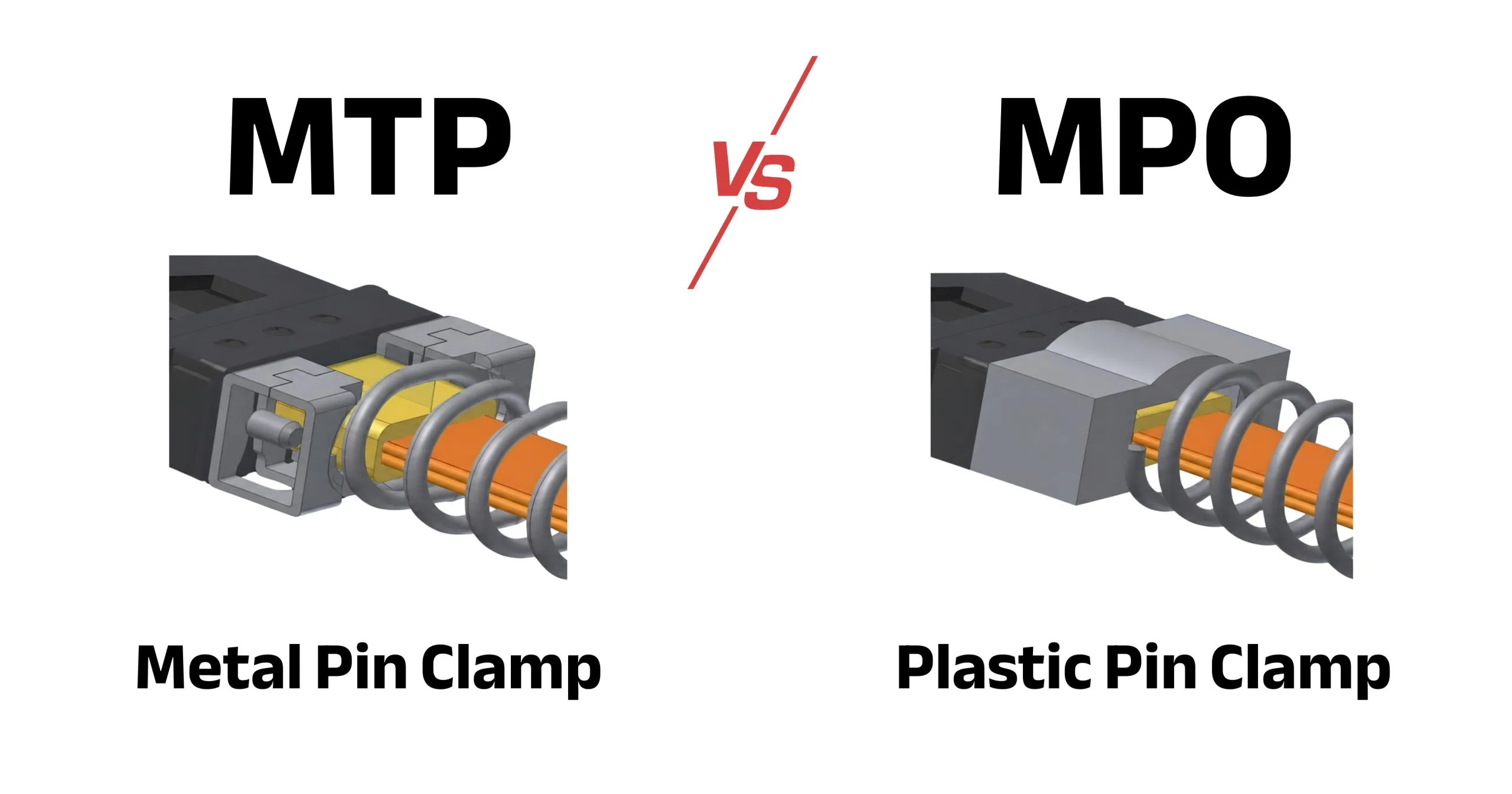 |
How Do the Performance Numbers Actually Compare?
The mechanical differences above translate directly into measurable optical and mechanical performance gaps.
On insertion loss, MTP® connectors deliver a typical range of 0.15 to 0.35 dB, compared to 0.35 to 0.75 dB for standard MPO. That improvement comes directly from the floating ferrule and elliptical guide pins, which produce more consistent fiber-to-fiber contact at every mating. In high-density links where multiple connectors are chained together, that loss differential compounds across every connection point and can determine whether a 400G or 800G link stays within budget.
On mating cycles, the gap is significant. Standard MPO connectors are rated for approximately 500 mating cycles under normal use. MTP® connectors exceed 1,000 cycles, more than twice the endurance, due to the metal pin clamp and optimized spring design (US Conec FAQs). For a static backbone that gets touched twice a year, that difference is academic. For a colocation environment where cross-connects shift weekly, it directly affects lifecycle cost.
Are MPO and MTP® Physically Compatible?
Yes, because MTP® complies with the same IEC 61754-7 and TIA-604-5 standards as generic MPO, an MTP® connector will physically mate with a standard MPO connector using the same adapter.
The compatibility runs in both directions. You can mix MTP® trunks with MPO cassettes or MPO patch cords with MTP® adapters without physical issues. The connectors use the same housing dimensions, the same push-pull latch mechanism, and the same fiber array geometry.
However, when an MTP® connector mates with a generic MPO, the performance floor drops to whatever the lower-spec connector delivers. You don't get MTP®-level insertion loss from a mixed pair. The weakest link in the optical path sets the floor for the whole connection. This matters on 400G and 800G links where loss budgets are tight, because mixing connector grades in a high-speed link defeats the purpose of specifying MTP® in the first place.
The practical rule: match grades end-to-end on performance-sensitive runs. Mixing is fine for less critical segments.
When Should You Specify MPO vs MTP®?
The right answer depends on three factors: link speed, reconfiguration frequency, and budget sensitivity.
Specify MTP® when:
Running 100G, 400G, or 800G parallel optics with tight loss budgets
Infrastructure will be frequently reconfigured
Mission-critical applications: defense, healthcare, broadcast, trading
Long-term total cost of ownership matters more than upfront unit price
Specify Generic MPO when:
Deploying static enterprise backbone runs
Budget constraints are the primary driver
Link is non-critical, performance headroom not a concern
Very high connector counts where cost per port dominates
What About Fiber Count and Speed Compatibility?
Both MPO and MTP® connectors share the same fiber count options: 8, 12, 16, 24, and up to 72 fibers in specialty configurations. The connector type doesn't change what fiber count you need; the speed standard does.
| Speed Standard | Connector | Fiber Type | Polish |
|---|---|---|---|
| 40GBASE-SR4 | MPO-12 | OM3/OM4 multimode | UPC |
| 100GBASE-SR10 | MPO-24 | OM3/OM4 multimode | UPC |
| 100GBASE-SR4 | MPO-12 | OM4/OM5 multimode | UPC |
| 400GBASE-SR8 | MPO-16 | OM4/OM5 multimode | APC |
| 800GBASE-SR8 | MPO-16 | OM4/OM5 multimode | APC |
| 400GBASE-DR4 | MPO-12/16 | Single-mode | APC |
| 800GBASE-DR8 | MPO-12/16 | Single-mode | APC |
For single-mode long-reach applications, APC polish is the right specification. APC reduces back-reflection, which matters on single-mode links with sensitive transceivers.
Not sure which multimode fiber grade your project needs? See our comparison: OM3 vs OM4 vs OM5: Which Multimode Fiber Is Right for Your Application?